

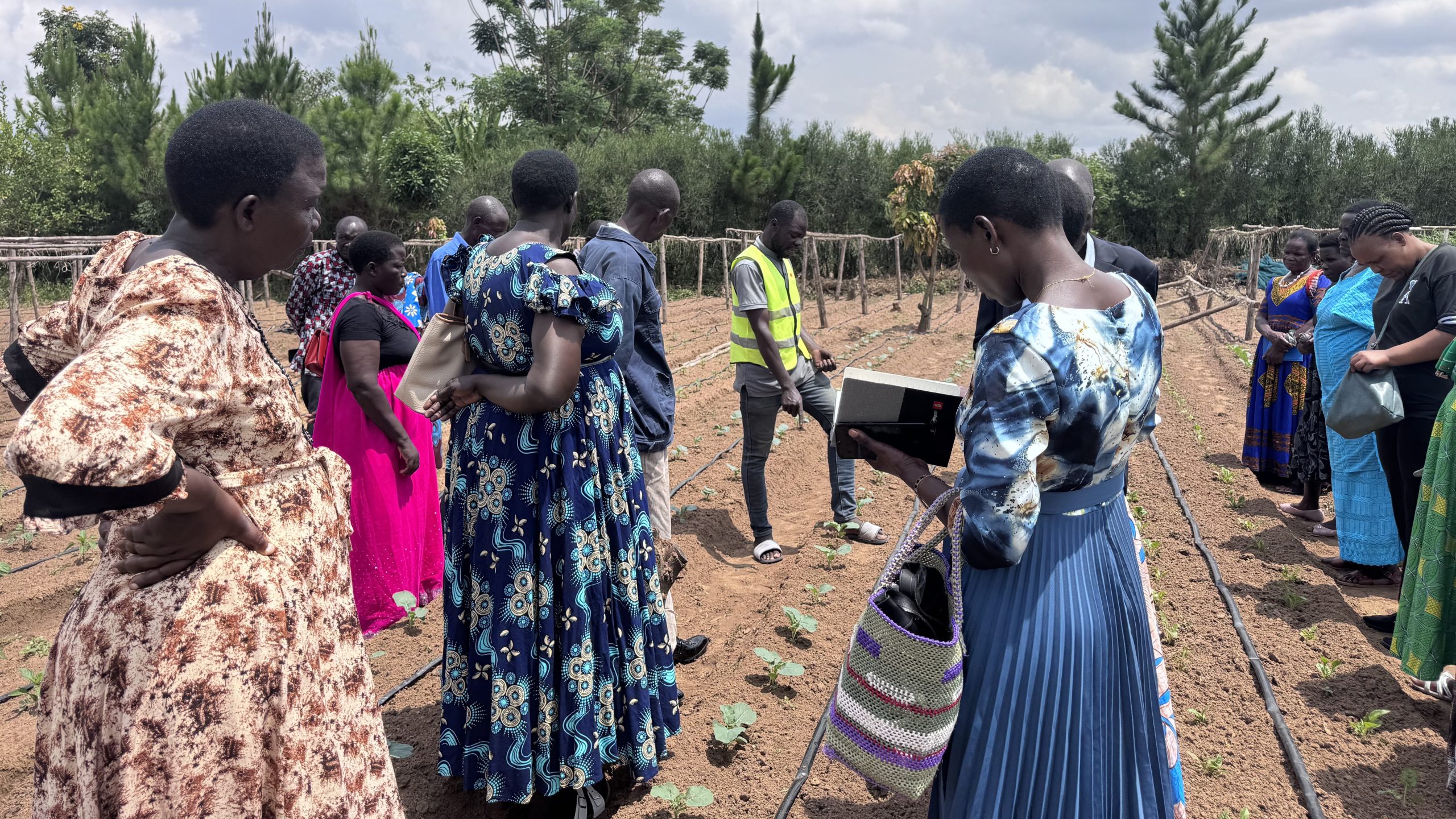
Photo: Smallholder farmers leveraging peer learning during a peer to peer learning activity in Tororo district (Photo by ACTADE)
Until the 2000s, Uganda’s agricultural extension system relied mainly on a public model in which government staff provided in-person advice to smallholder farmers. While valued by farmers, the system has long struggled with understaffing and limited reach.
This has created space for digital extension services, largely provided by private sector actors. Agricultural technology (agritech), telecom and financial technology (fintech) companies, input suppliers and nongovernmental organisations now use such services to provide climate information, advice, inputs, finance and market links.
These services can widen access to adaptation knowledge, but their reach is often shaped by commercial incentives and donor priorities rather than smallholders’ needs. Low digital literacy, weak connectivity, limited affordability and fragmented delivery further restrict access, especially for poorer farmers.
More inclusive and sustainable scaling will require blended finance, better coordination, stronger regulation and interoperable systems.
About the Authors
Annet Nakyeyune, Viola Musiimenta, Lilian Motaroki, Saida Nakaziba
Cite this publication
Nakyeyune, A., Motaroki, L., Musiimenta, V. and Nakaziba, S. (2026). Making private digital extension services work for Uganda’s smallholders. IIED, London.
Available at https://www.iied.org/22759iied and https://actade.org/making-private-digital-extension-services-work-for-ugandas-smallholders/